Welcome to the new Program in Analytical Psychology
Download the ISAP ZURICH 4 color brochure in English as a PDF file. (595.69 kB)
Download die 4-farbige Broschüre über ISAP ZURICH in Deutsch als eine PDF-Datei. (597.92 kB)
Download information about ISAP ZURICH in English (A4 size / black and white) as a PDF file. (274.79 kB)
Download Information über ISAP ZURICH in Deutsch (A4 Format und schwarz/weis) als PDF-Datei. (280.28 kB)
Download "Zur Wissenschaftlichkeit der analytischen Psychologie" in German as a PDF file. (440.63 kB)


Introduction


The serious problems in life, however, are never fully solved....

The meaning and purpose of a problem seem to lie not

in its solution, but in our working at it incessantly.

(C.G. Jung, Stages of Life, CW 8, § 771


Carl Gustav Jung’s Analytical Psychology offers help in dealing with psychological difficulties and also encourages and supports the development of the personality. Analytical Psychology can therefore be well applied for the therapeutic treatment of psychological disturbance — and also for depth analysis and counseling with healthy people. Such people might be struggling with important life questions and decisions, suffering under difficult circumstances or generally interested in their own personal development.


In this brochure you will learn more about the person and researcher, C. G. Jung, about the basic underpinnings of Jungian Psychology and about the training and teaching offerings of our school, The International School for Analytical Psychology, ISAP ZURICH.


 The Essentials at a Glance


ISAP ZURICH


  • Is dedicated to the further development and expansion of C.G. Jung’s Analytical Psychology


  • Offers training in Analytical Psychology, to include its application in the context of psychotherapy. Jungian Psychotherapy is the most widely used form of psychotherapy in Switzerland.


  • Offers a continuing education program, which lasts a minimum of two semesters and can be useful either in the everyday practice of many professions or for personal development or for furthering a scientific interest in Analytical Psychology.


  • Offers public lectures and events, at minimal costs in order to make them accessible to a large public.


  • Offers all training in English and German.


  • Offers a Diploma Program, which is recognized by the IAAP (International Association for Analytical Psychology) and its 50+ Jungian professional groups and Institutes world-wide.


  • Has the largest body of qualified and experienced Jungian trainers and teachers.


  • Accommodates the needs and interests of students from many countries around the world with a myriad of academic backgrounds, which assures a unique international atmosphere.


  • Is a training program of AGAP (Association of Graduate Analytical Psychologists) the largest Jungian IAAP Society with over 650 members world-wide.


  • Coordinates a free psychological counseling service to arrange for analytic and therapeutic services.


  • Is dependent upon donations and voluntary support from members, supporters and friends.


Carl Gustav Jung  


The Swiss psychiatrist C.G. Jung is without a doubt one of the most important  pioneers of modern psychology as well as one of the greatest thinkers of the twentieth century. He was born in 1875 in Kesswil, Switzerland and did his early schooling as well as his medical training in Basel. While working as a psychiatrist at the famous Burghölzli Clinic in Zurich, Jung came in contact with the writings of Sigmund Freud. Jung initiated a friendship with Freud and became one of Freud’s most respected students until the relationship was mutually broken off over differences in theoretical understanding as well as personality differences.


Following the break with Freud, Jung’s own original ideas gained form and led to the existence of his Analytical Psychology. Over the years, working as a doctor and researcher, Jung produced a comprehensive body of writings, which go far beyond the realms of psychology and psychiatry in their meaning for our times. In 1935 he was named Professor at the ETH in Zurich and in 1944 was named Extraordinary Professor at the University of Basel in Medical Psychology.


His understanding of depth psychology has influenced thought in many different fields, providing special and important stimulus to scientific research. 


In 1903 Jung married Emma Rauschenbach and together they had five children. His family home was in Küsnacht on the lake of Zurich, where he also kept is analytic practice. He died in Küsnacht on June 6, 1961.


The Analytical Psychology of C.G. Jung: Key Concepts


The pioneering work that Jung contributed to the understanding of humanity and soul can be characterized as follows:


  • Jung discovered the collective unconscious as the universal basis of our experience of soul and the urge to live life creatively.


  • Jung brought the concept of the archetype into scientific discourse.


  • Jung created a new typology, to which the concepts of extraversion and introversion belong. These concepts are now a normal part of everyday speech practically world-wide.


  • Jung developed the concept of individuation. The individuation process implies that the development of soul belongs to a coming-to-one’s-self. This process requires diverging from collective norms and supporting the development of the full potential of the personality.


  • In seeking an authentic self, one becomes confronted with many different aspects of the personality. These include the persona, the shadow, the anima and animus as well as the Self. These terms have also become a part of everyday language.


  • As researcher of the deeper dimensions of the unconscious, Jung dealt especially with fairy tales, mythology, religion and alchemy. In so doing he developed a completely new conception of symbol.


  • The interpretation of unconscious contents follows in consideration of a telos or final aim. Thereby emerge compensatory meanings that spring from the psyche’s self-regulating tendency.


  • Jung conceived of the psyche as presenting an objective reality, which could also express itself in so-called synchronicities. In his view this supports the fact of correspondence between the inner world of the psyche and the concrete world outside.


  • Jungian therapeutic treatment is not a matter of following generally applied methods. Far more, therapy is oriented to the variable characteristics and needs of each individual.


  • The suffering of soul is not simply seen as a curable disturbance. Rather, it is considered to be a necessity and impulse for psychological development. The tasks of therapy are to support the individual on the way to becoming one’s self, to support his or her developing consciousness, to enable a greater sense of personal authenticity, and to bring one’s own creativity to life.


  • The goal of therapy is to enable the individual to experience something larger than him/herself, to open to the language of the unconscious, and to discover meaning in life.


  • The therapeutic relationship is seen as a real relationship between two people, and also as a container which is fundamental to the therapeutic process.


  • Analytical Psychology understands psychic reality to be determined by the interplay of opposites. Therefore the Jungian perspective is characterized  by work with many polarities, for instance:


    • Individual vs. Collective: The priority of the individual in relation to the collective is stressed, but at the same time the importance of collective factors is acknowledged, in particular how they influence the unconscious of the individual, the community and culture.


    • Consciousness vs. Unconsciousness: Development of consciousness is considered an urgent task, but at the same time one’s relatedness to the unconscious and its instinctive knowledge is considered necessary for reaching the therapeutic goal.


    • Reality of the Inner world vs. Reality of the Outer World:  While the creative encounter with personal feelings and inner images is considered the core of therapeutic work, the necessity and importance of a realistic relatedness to the outer everyday world is acknowledged as well.


    • Scientific Knowledge vs. Psychological Reality: While striving to recognize and further the scientific knowledge of the day, Analytical Psychology also guards against reducing complex psychological realities to generalizable concepts and subjecting them to normative strategies of treatment.


What ISAP Offers in Training and Teaching


The Diploma in Analytical Psychology


ISAP ZURICH offers a full time course program, which concludes with a Diploma in Analytical Psychology. Applicants for these post-graduate studies must be at least 28 years old, hold a Masters or Doctoral degree, and must have had professional experience in their field.


The training consists of a minimum of 8 semesters of study and is divided into two parts:


1. During the first part of training, which is primarily theoretical, the student has the status of Training Candidate. This section of study is terminated with the Propaedeuticum Exams, which are given in eight subject areas.


2. The second part of the training leans heavily on the practice of analytical psychology. The student, now a Diploma Candidate, is required to conduct a minimum of 300 hours of analysis with individual clients as well as to acquire a minimum of 200 hours of supervision in both individual and group settings.


The eight subject areas of the Propaedeuticum exams are: Fundamentals of Analytical Psychology, Psychology of Dreams, Psychological Interpretation of Myths and Fairy Tales, Fundamentals of Ethnology, Comparative Studies of Religion, Developmental Psychology, Comparative Study of Neurosis, Fundamentals of Psychopathology and Psychiatry.


The Diploma exams cover the following seven subject areas: Case Exam, Psychiatry with special attention to differential diagnosis, Psychological Understanding of Dreams in Clinical Practice, Psychological Understanding of Myths and Fairy Tales, Psychological Understanding of Pictures, The Individuation Process and its Symbols, Discussion of Diploma Thesis.


Belonging to the training is the attendance of lectures, seminars and control case colloquia that address these areas. Every semester offers around 500 hours of theoretical and didactic instruction conducted in English and German  by ISAP’s faculty, which consists of some 70 analysts. The program is enhanced with instruction by guest lecturers from around the world.


During the training, the student must complete a variety of written assignments including: Two symbol papers, the write-up of the Association Experiment, case reports of varying lengths, and the Diploma Thesis, which is a comprehensive work of at least 80 pages.


All students are required to complete a clinical internship in a psychiatric or psychosomatic institution.  This can be undertaken either in an inpatient or outpatient facility. The student can fulfil any function as long as he has a continuous contact with patients and is exposed to a broad spectrum of psychic illness.


The core of the training is the personal analysis, which must be conducted with an Accredited and/or Training Analyst of ISAP for a minimum of 300 hours. The analysis serves the development of the personality and the conscious orientation toward the reality of the psyche and its limits. This work on ones own psychic reality and limitations helps reduce the danger of personal interference from the analyst’s side in the early work with clients.


There is a careful selection process in place to guarantee that the prospective candidate fulfils the human, psychological and intellectual prerequisites necessary for the responsible carrying out of an analytic practice in the future. Upon admission to the program each candidate is followed throughout the duration of training by his or her own personal selection committee.


The exciting and fertile atmosphere at ISAP ZURICH is due to the fact that our students and teachers come from many different countries and academic backgrounds. This provides a unique international climate, which is a major advantage to our training in analytical psychology.


Continuing Education in Analytical Psychology


Study at ISAP ZURICH is also possible for individuals who wish to learn more about C.G. Jung’s analytical psychology but have no intention to acquire a Diploma or to participate in the full course of study: Within the framework of its regular program of lectures and seminars ISAP ZURICH offers a continuing education program that spans at least two semesters and ends with the conferral of a document attesting to a deepened theoretical understanding of analytical psychology. The requirements for the completion of this special continuing education are: active participation in lectures and specific seminars over a minimum of two semesters, and the successful completion of an oral and written exam. The oral exam is on the Fundamentals of Analytical Psychology and lasts 45 minutes. The written work is a symbol paper. It is also strongly recommended that the participant be in analysis during the continuing education. This will help the individual to better understand the analytic theory being taught and also serves to deepen the experience with analytical psychology. The document provided at the end of the continuing education program does not allow the individual to practice as a therapist or analyst.


Other Ways to Attend ISAP


Besides offering a full training program in analytical psychology and continuing education programs for persons in tangential professions, ISAP ZURICH opens its doors to persons from all walks of life, who are interested in analytical psychology, C. G. Jung or even just specific aspects of Jung’s life work:


Lectures are open to the public, whereby individuals may attend as auditors without the formality of registration. A nominal entrance fee is paid on a time-for-time basis.


Alternatively, individuals may register as matriculated auditors who are entitled to attend all the lectures offered in a given semester. In this case a one-time, comprehensive fee is paid from semester to semester. Individuals wishing to register as matriculated auditors should contact the Director of Studies.


Organizational Structure


ISAP ZURICH is the training program in analytical psychology of AGAP run by a Zurich sub-group of its members. The group functions in accordance with Swiss Association Law. ISAP’s officers and committee members are regularly elected by the community of participants, with re-election possible.


The Officers Committee consists of seven elected members with designated functions as follow:


President (coordinates the business of the Officers Committee, chairs the meetings of the OC as well as the general meetings of the participants, represents ISAP to the public)


Vice-President (substitutes for President in his/her absence and is responsible for legal questions, communication issues, printing of documents and taking of Minutes at all meetings)


Treasurer (bookkeeping, budget Planning, controlling, computer questions, personnel)


Director of Administration (first point of contact for interested students and responsible for student loan questions, visa questions, organizational and business questions, infrastructure, organization of seminars)


Director of Studies (Chair of the Training Committee, advisor to students, student administrator, exams, Counseling Service)


Director of Program (Chair of the Program Committee, organizer of the semester program of lectures, seminars and colloquia, creation and administration of the library)


Director of Admissions (Chair of the Admission Committee, prepares and leads Selection Committee meetings, carries out decisions of the Selection Committee)


Location and Directions to our Site


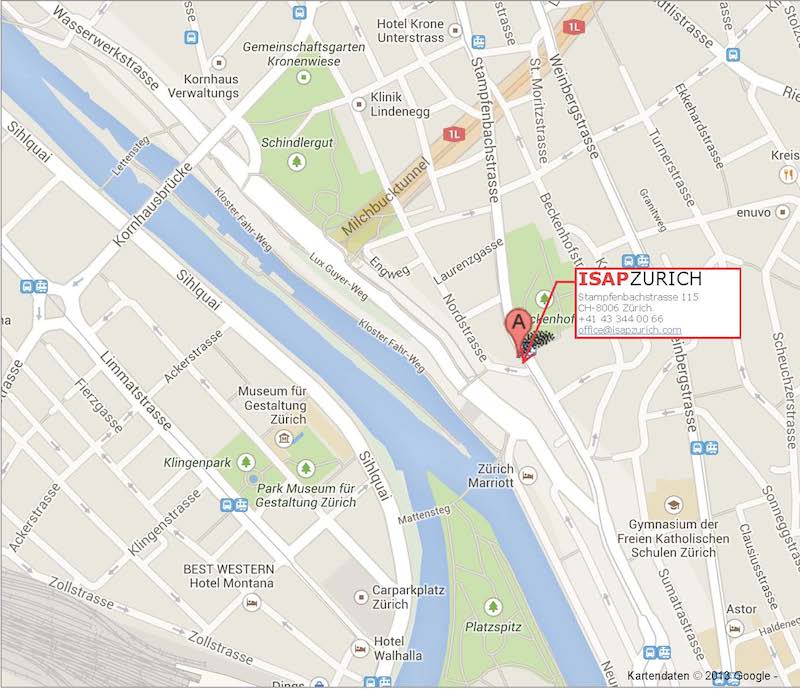
ISAP ZURICH is located at Hochstrasse 38, 8044 Zurich in a quiet neighborhood near the University quarter of Zurich. The twelve rooms of the School, which include a library, secretariat and student kitchen, are found on three floors of a modern building.


ISAP ZURICH is easily accessible by public transportation:

Bus number 33 stops at “Hinterbergstrasse”

Trams number 5 and 6 stop at “Fluntern” and Trams number 9 and 10 stop at “Haldenbach”.

Each of these stops is a five-seven minute walk from the school.

There is parking available for one hour in the area and a parking garage is located at Fluntern for longer periods.

1   Park

5   Flower Shop / Pharmacy

9   Credit Suisse / Poste

2   Russo Comestibles

6   Restaurant Vorderberg

10 Al Forno, Italian Restaurant

3   Italian Restaurant

7   Huber Comestible

11 Copy Center / Bookshop / Wine Bar

4   Bakery Honold

8   Migros

12 ETH / University with Mensas and Libraries


Free Counseling Service


ISAP ZURICH maintains a Counseling Service that consults with individuals seeking analysis or psychotherapy and refers them to qualified ISAP analysts or to Diploma Candidates who work at reduced rates for the duration of the training. All Diploma Candidates hold degrees of higher education and conduct analysis under the supervision of experienced Supervisors. Coming from many different countries and a variety of academic backgrounds, Diploma Candidates offer analysis and therapy in a number of languages such as English, German, French, Italian, Spanish, Portuguese, Swedish, Japanese.


Initial interviews and placement referrals are conducted through the Director of the Counseling Service and are free of charge.


Donations


ISAP ZURICH is primarily funded through the tuition fees of students and the annual participation fees paid by the participating analysts of ISAP. Since it is a private school it receives no funding from public or governmental sources. Therefore ISAP is dependent upon the good will of private donors and friends of the training to help it stay financially sound. Donations can be made in the form of singular and one-time contributions, repeated and regular donations, or in the form of bequeathed inheritance.